
Ocean Autonomy Cluster member Zeabuz and Damen Folla have developed ZeaWatch Docking Assist, a new system designed to help aquaculture workboats manoeuvre safely around cages, docks and infrastructure both above and below the water.
Each year, workboats operating at fish farms risk collisions with anchor chains, nets, mooring systems and other infrastructure hidden beneath the surface. Such incidents can lead to damage, costly repairs and downtime. ZeaWatch Docking Assist is designed to give operators a clearer picture of what is happening around the vessel and reduce that risk.
The solution combines sonar, cameras, 4D radar and GNSS with object-detection algorithms. Sensor data is brought together in ZeaWatch to create a real-time view of the vessel's surroundings, including objects that would normally be invisible to the crew below the waterline.
The operator sees nearby objects, distances and warning zones through a single interface, giving additional support during approaches, docking, reversing and other close-quarter operations around aquaculture facilities.
“ZeaWatch Docking Assist is based on well-proven technology. What is unique about the system is that it was developed with fish farming in mind. It supports approaches, dockings, backing and close-quarter operations around cages and docks,” says Stig Rune Nørbech, CCO at Damen Folla.
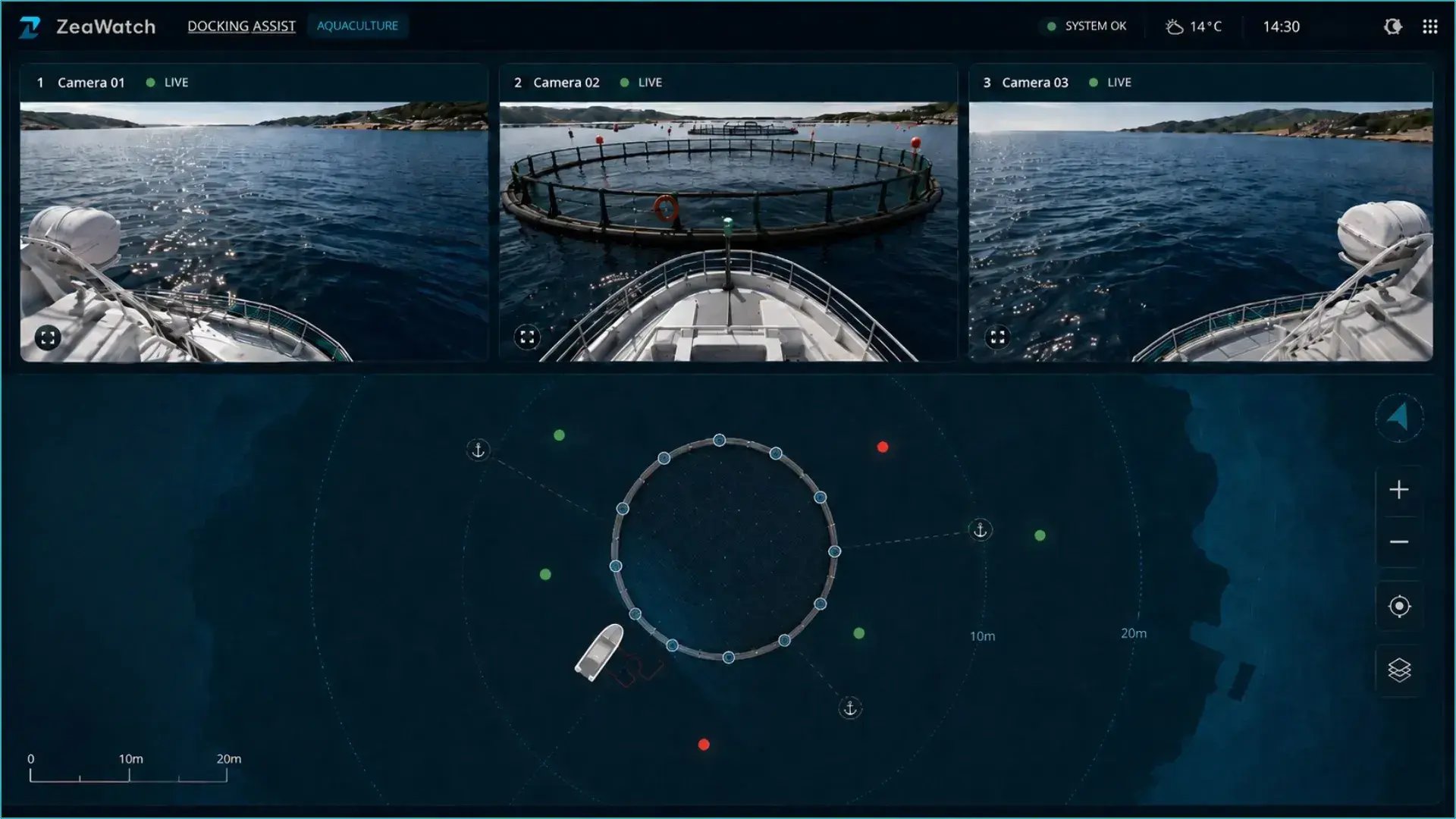 ZeaWatch Docking Assist Interface. Illustration: Damen/Zeabuz
From autonomous vessels to aquaculture operations
The development builds on an existing collaboration between Zeabuz and Damen Folla. The companies previously worked together on ZeaFalcon, a seven-metre HDPE vessel equipped with a Zeabuz autonomy system that supports autonomous navigation, collision avoidance, remote command and control and autodocking.
The idea for ZeaWatch Docking Assist for aquaculture emerged when Stig Rune Nørbech contacted Zeabuz CEO and CTO Øyvind Smogeli in May 2025 to explore whether similar technology could address challenges faced by aquaculture workboats. At the time, Zeabuz was already completing a docking-assistance solution for an electric sightseeing vessel.
The result was a dedicated version adapted to an environment where much of the critical infrastructure cannot be seen from the vessel.
Building blocks for increased autonomy
For Zeabuz, the project is also part of a broader development towards increased automation and autonomy in maritime operations.
As aquaculture operations move further offshore and into more exposed locations, vessels are expected to become larger and more complex. Zeabuz sees navigation support and autonomous technology as tools to assist crews rather than replace them, with the aim of making operations safer, more efficient and more productive.
 Øyvind Smogeli, CTO of Zeabuz. Photo: Lars Bugge Aarset/Fremtidens Industri
“Our approach to autonomous technology and navigation support is not aimed at displacing the crew. What we are seeking to do is rather to develop solutions that support the operators, making their work safer, more efficient and more productive,” says Øyvind Smogeli.
The ZeaWatch Docking Assist project demonstrates how technologies developed for autonomous vessels can be transferred into practical tools for existing maritime operations, while also providing building blocks for further autonomy in aquaculture.
Read more:
Zeabuz: ZeaWatch Docking Assist for Aquaculture
Damen: Increasing autonomy in aquaculture with ZeaWatch Docking Assist