Great enthusiasm for autonomous ferries
35 participants were gathered to learn more about autonomous ferries during the Ocean Autonomy...

As the maritime industry explores autonomous and semi-autonomous vessels, reliable 5G connectivity is emerging as a cornerstone for safe and efficient operations. Projects across Norway are demonstrating how high-speed, low-latency networks enable real-time monitoring, control, and data management for vessels.
The Lavik–Oppedal route across the Sognefjord, operated by Fjord1, is set to become the world’s first autonomous ferry connection. The route is 5.6 kilometers long, part of the E39 highway network, and is Norway’s ninth largest ferry connection, with 1.2 million passenger car equivalents recorded in 2022.
In the first half of 2026, Fjord1 will receive four zero-emission ferries that will begin operating on the route from September 2026, which will gradually become autonomous by 2030. The goal is for the vessels to eventually operate as self-sailing ferries with a high degree of automation. These ferries will rely on ultra-fast and stable network connectivity, with Norwegian Electric Systems (NES) providing the autonomy system that enables them to sail from quay to quay, dock, load, and unload with minimal human intervention.
As a sub-supplier to NES we find SentiSystems that helps increase system resilience by providing advanced sensor data processing, enabling operation even when GPS/GNSS signals are jammed or spoofed.
.jpg?width=720&height=480&name=SentiSystems%20Foto%20Lars%20Bugge%20Aarset%20Ocean%20Autonomy%20Cluster%20(17).jpg) Arne Kjørsvik, CEO of SentiSystems. Photo: Lars Bugge Aarset/Fremtidens Industri
Arne Kjørsvik, CEO of SentiSystems. Photo: Lars Bugge Aarset/Fremtidens Industri
“SentiSystems’ solutions enable robust processing of sensor data, allowing vessels to operate safely even in environments where GPS/GNSS signals are jammed or spoofed,” says Arne Kjørsvik, CEO of SentiSystems.
This capability is critical for increasing system resilience in safety-critical maritime operations.
SentiSystems is a member of both Ocean Autonomy Cluster and NORDSEC Nordic Defence and Security Cluster.
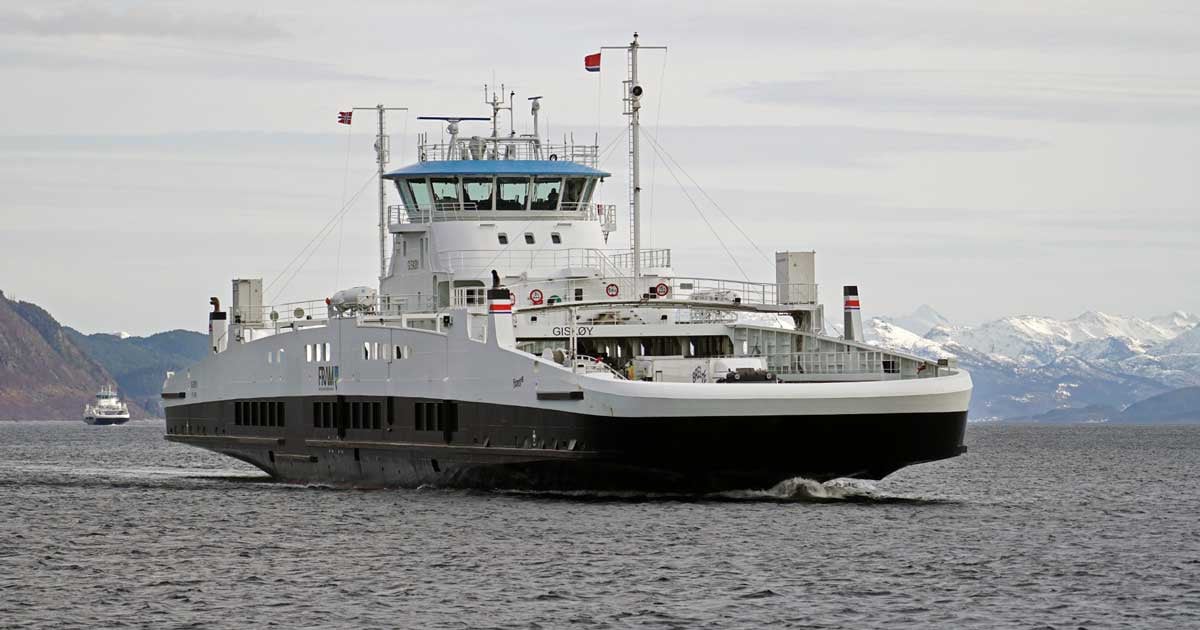 Photo: Fjord1
See also: Situation awareness by design: Advancing remote operation of autonomous vessels
Autonomous operations generate enormous amounts of data, and stable, high-speed data traffic is essential. This applies broadly to the future of autonomous maritime transport, beyond individual ferry routes, enabling developers and operators to test, monitor, and refine autonomous systems.
“Autonomy at sea requires extremely high uptime and low latency. Without reliable 5G, the ferries could not operate safely or efficiently,” says Ørjan Midttun, IT Manager at Fjord1.
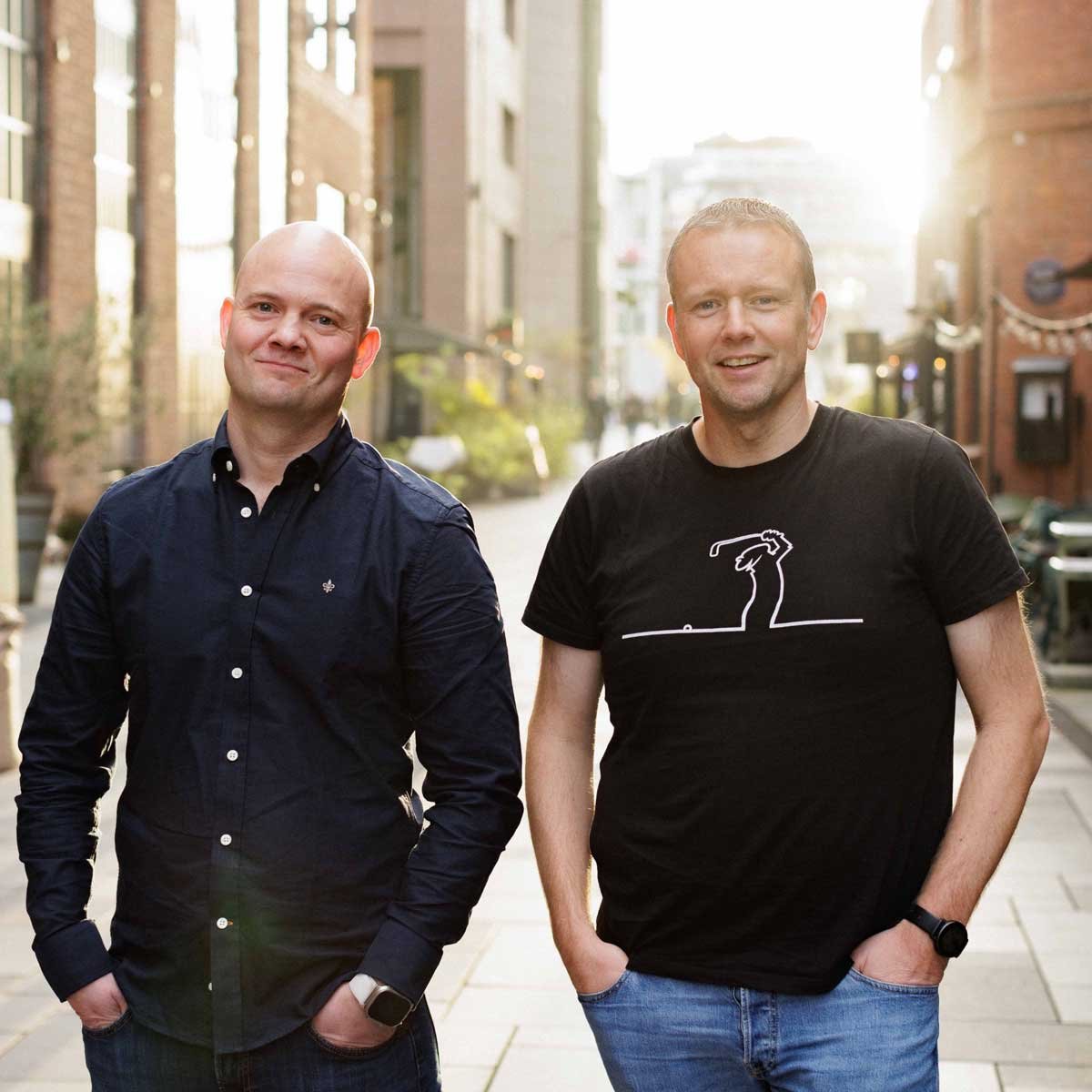 Ole Magnar Lillestøl and Ørjan Midttun. Photo: Fjord1
The ferries continuously transmit real-time data from cameras, sensors, and navigation systems to the control center in Florø. To handle this, Telia is deploying new 5G mmWave technology, offering speeds of up to 800 megabits per second.
“5G is the backbone of this operation. It allows uninterrupted communication with all Fjord1 operational systems on the ferries in real time, even under challenging fjord conditions,” says Tom Erik Nilsen, Sales Director at Telia.
According to Espen Frydenlund, Business Developer at Telia Norway, Norwegian autonomy environments have already demonstrated how far multi-sensor navigation and SLAM-based technologies have advanced.
Simultaneous Localization and Mapping - SLAM is a method used in robotics and autonomous navigation where a vessel, vehicle, or robot simultaneously builds a map of its surroundings and calculates its own position within that map, without relying on GPS.
.jpg?width=6960&height=4640&name=Zeabuz%20Zea%20Falcon%20-%20Foto%20Lars%20Bugge%20Aarset%20Fremtidens%20Industri%20(35).jpg) ZeaFalcon Uncrewed Surface Vessel (USV) from Zeabuz. Photo: Lars Bugge Aarset/Fremtidens Industri
ZeaFalcon Uncrewed Surface Vessel (USV) from Zeabuz. Photo: Lars Bugge Aarset/Fremtidens Industri
Zeabuz develops solutions for autonomous and remotely supervised operations, where ships can “see”, understand and navigate their environment independently.
“Zeabuz has already shown how far Norwegian autonomy expertise has progressed, with advanced multi-sensor systems and SLAM-based navigation that allow vessels to operate safely even without GPS. This type of local autonomy provides impressive onboard robustness,” says Frydenlund.
Zeabuz delivers intelligent navigation, autonomy and remote control solutions for vessels.Frydenlund emphasizes that scaling such solutions from pilots to commercial operations requires more than onboard intelligence alone.
“To scale these solutions to commercial deployment, you need a communications infrastructure that delivers predictability, low latency, and high availability. This is where 5G Standalone becomes decisive.”
.jpg?width=6000&height=4000&name=Dark%20Drones%202026%20-%20Demo%20Day%20Foto%20Lars%20Bugge%20Aarset%20Fremtidens%20Industri%20(8).jpg) Øyvind Smogeli demonstrating Zeabuz Remote Operations Centre (ROC) in Nyhavna, Trondheim. Photo: Lars Bugge Aarset/Fremtidens Industri
Øyvind Smogeli demonstrating Zeabuz Remote Operations Centre (ROC) in Nyhavna, Trondheim. Photo: Lars Bugge Aarset/Fremtidens Industri
Se also: Zeabuz delivers autonomy solution to Swedish zero-emission ferry
5G Standalone is a full 5G network architecture with a dedicated core network that delivers lower latency, more stable performance, and the ability to allocate dedicated network resources, essential for real-time control and autonomous operations.
With 5G Standalone (SA), dedicated network resources and network slicing can be used to separate critical vessel traffic from other mobile network usage.
“With dedicated network resources and network slicing, autonomous vessels can share sensor data, video, and navigation information with shore-based control centers in near real time, without critical functions being affected by other traffic in the mobile network,” Frydenlund explains.
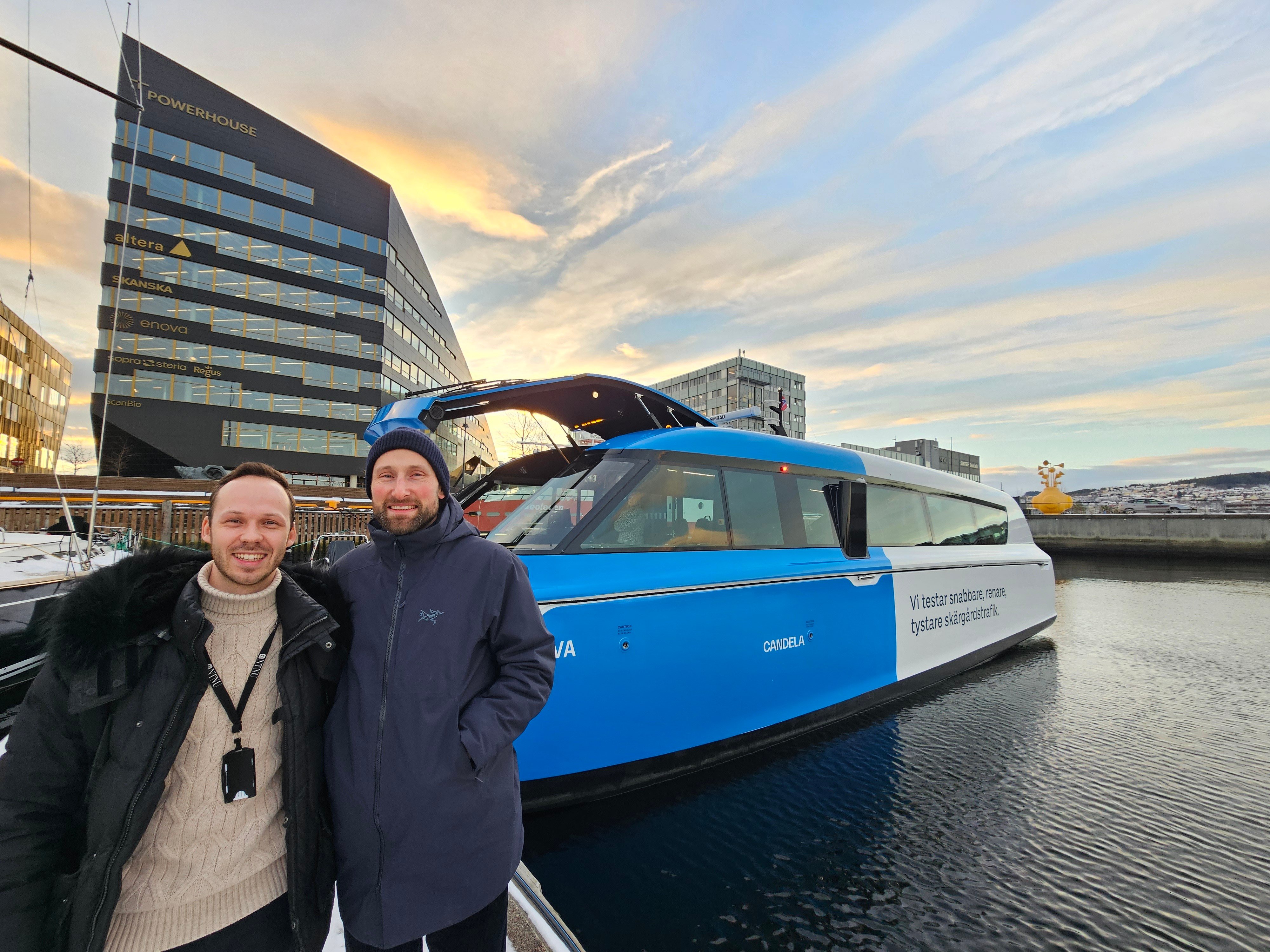 Alexey Gusev, NTNU Shore Control Lab and Espen Frydenlund during Frostabåten test-sailing. Photo: Telia
See also: Zeabuz expands into defense and security with new dual-use autonomy platform
As another example of how 5G enables advanced maritime operations, Frostabåten has conducted test sailings with an electric hydrofoil on the Trondheimsfjord. The tests explore how semi-autonomous features and new transport concepts can be developed for short fjord routes using energy-efficient, zero-emission vessels.
Frostabåten uses a Candela P‑12 hydrofoil, which lifts the hull out of the water to reduce resistance and energy consumption, and can travel between Frosta and Trondheim in about 25 minutes.
.jpg?width=6960&height=4640&name=Frostab%C3%A5ten%20torsdag%2018%20desember%202025%20-%20Foto%20Lars%20Bugge%20Aarset%20Fremtidens%20Industri%20(11).jpg) "Frostabåten" - Candela-P12 electric hydrofoil. Photo: Lars Bugge Aarset/Fremtidens Industri
"Frostabåten" - Candela-P12 electric hydrofoil. Photo: Lars Bugge Aarset/Fremtidens Industri
During the tests, NTNU Shore Control Lab demonstrated how passenger vessels can be monitored from shore using 5G connectivity. The solution allows high-quality video streaming directly from the vessel to a control room, providing enhanced situational awareness and a basis for further development of remote monitoring and operational support.
 Ole Andreas Alsos, head of Shore Control Lab, said:
“We used the 5G network to transmit high-quality video images with extremely low latency from Frostabåten to a control room at Shore Control Lab. This allowed us to monitor the test operation from shore.”
Frydenlund also highlights Frostabåten and NTNU’s AutoTeaming project as a full-scale research platform for human–machine interaction and autonomous vessel operations under real conditions.
Autoteaming is a research and development project led by NTNU that develops and tests solutions for effective teamwork between humans and autonomous vessels. The project builds technologies, methods, and control-center concepts that enable operators to supervise, support, and collaborate with autonomous systems in real time, with a strong focus on safety, decision support, and human–machine interaction in real operational environments.
“Through Frostabåten and the AutoTeaming project, researchers can test situational awareness, decision support, and remote operations in real environments. The vessel depends on stable high-speed connectivity to transfer and analyze large volumes of data in real time,” he says.
The practical experience from Frostabåten shows how 5G not only supports autonomous functions, but also provides a technological foundation for real-time monitoring and control under realistic operational conditions.
“Taken together, Zeabuz and Frostabåten show that Norway is at the forefront of maritime autonomy, and that 5G Standalone is a prerequisite for moving the technology from research environments into regular, safe, and scalable operations,” Frydenlund says.
See also: Frostabåten – Successful test sailing of electric hydrofoil in Trondheimsfjorden
 Ole Andreas Alsos, NTNU Shore Control Lab. Photo: Lars Bugge Aarset/Fremtidens Industri
SentiSystems and Zeabuz are members of Ocean Autonomy Cluster and NORDSEC Nordic Defence and Security Cluster, and both companies are incubator ventures in FI Ocean Space Incubator. The Frostabåten project is led by FI Ocean Space Incubator, bringing together industry and research partners to test and mature new autonomous maritime solutions. NTNU Shore Control Lab is a key collaboration partner for Ocean Autonomy Cluster and Testination, and also serves as a central partner in the MIDAS – Humans in Future Maritime Operations project.
Se also: Frostabåten: A real-world testbed for the future of autonomous maritime travel
.jpg?width=720&height=480&name=Frostab%C3%A5ten%20torsdag%2018%20desember%202025%20-%20Foto%20Lars%20Bugge%20Aarset%20Fremtidens%20Industri%20(6).jpg) "Frostobåten" Test sailing in Trondheimsfjorden. Photo: Lars Bugge Aarset/Fremtidens Industri
"Frostobåten" Test sailing in Trondheimsfjorden. Photo: Lars Bugge Aarset/Fremtidens Industri
35 participants were gathered to learn more about autonomous ferries during the Ocean Autonomy...
The Ocean Autonomy Cluster keeps growing, and we warmly welcome the leading nationwide public...