Offshore Sensing joins Ocean Autonomy Cluster
Offshore Sensing becomes a new member of Ocean Autonomy Cluster to strengthen collaboration on...

– A breakthrough for emission-free and autonomous mobility at sea.
This week, an electric hydrofoil from Swedish Candela was tested and trial-sailed in Trondheim Fjord as part of the Frostabåten project. The tests represent an important step toward new emission-free commuter routes, and eventually more autonomous solutions for passenger transport at sea.
The project is led by Linda Hald, project manager for Frostabåten, through FI Ocean Space Incubator. Its goal is to explore how electric hydrofoils can be integrated into future public transport offerings, both for commuters, tourism, and new mobility concepts.
.jpg?width=6000&height=4000&name=Frostab%C3%A5ten%20tirsdag%20-%20Foto%20Lars%20Bugge%20Aarset%20Fremtidens%20Industri%20(45).jpg) Candela P‑12 arrived in Trondheim by ship. Photo: Lars Bugge Aarset/Fremtidens Industri
Candela P‑12 arrived in Trondheim by ship. Photo: Lars Bugge Aarset/Fremtidens Industri
During the pilot week, the vessel was sailed on routes between Trondheim, Frosta Brygge at Småland, Leksvik, Munkholmen, and Grilstad Marina, in addition to several trips in Trondheim Fjord. The trips served both as technology tests and as data collection opportunities in collaboration with research environments.
– We have brought together the entire ecosystem around the project. Public actors, industry, research institutions, and technology suppliers have all been involved. Now we have shown that this can be realized in practice, says Hald.
.jpg?width=6960&height=4640&name=Frostab%C3%A5ten%20torsdag%2018%20desember%202025%20-%20Foto%20Lars%20Bugge%20Aarset%20Fremtidens%20Industri%20(11).jpg) At 15 knots speed, the foils lift the hull out of the water and the boat flies. Photo: Lars Bugge Aarset/Fremtidens Industri
At 15 knots speed, the foils lift the hull out of the water and the boat flies. Photo: Lars Bugge Aarset/Fremtidens Industri
A key part of the tests was collaboration with NTNU Shore Control Lab, which demonstrated how passenger ferries can be monitored from shore-based control rooms.
– We equipped Frostabåten with cameras and communication equipment that allow us to stream 360-degree video from the vessel over the 5G network to our control room at Shore Control Lab in Nyhavna, explains Ole Andreas Alsos, head of Shore Control Lab and professor of interaction design at the Department of Design.
NTNU developed a dedicated Gateway, a compact and user-friendly box that connects to power, cameras, and antennas. The solution collects and sends high-quality audio and video streams directly to the control room.
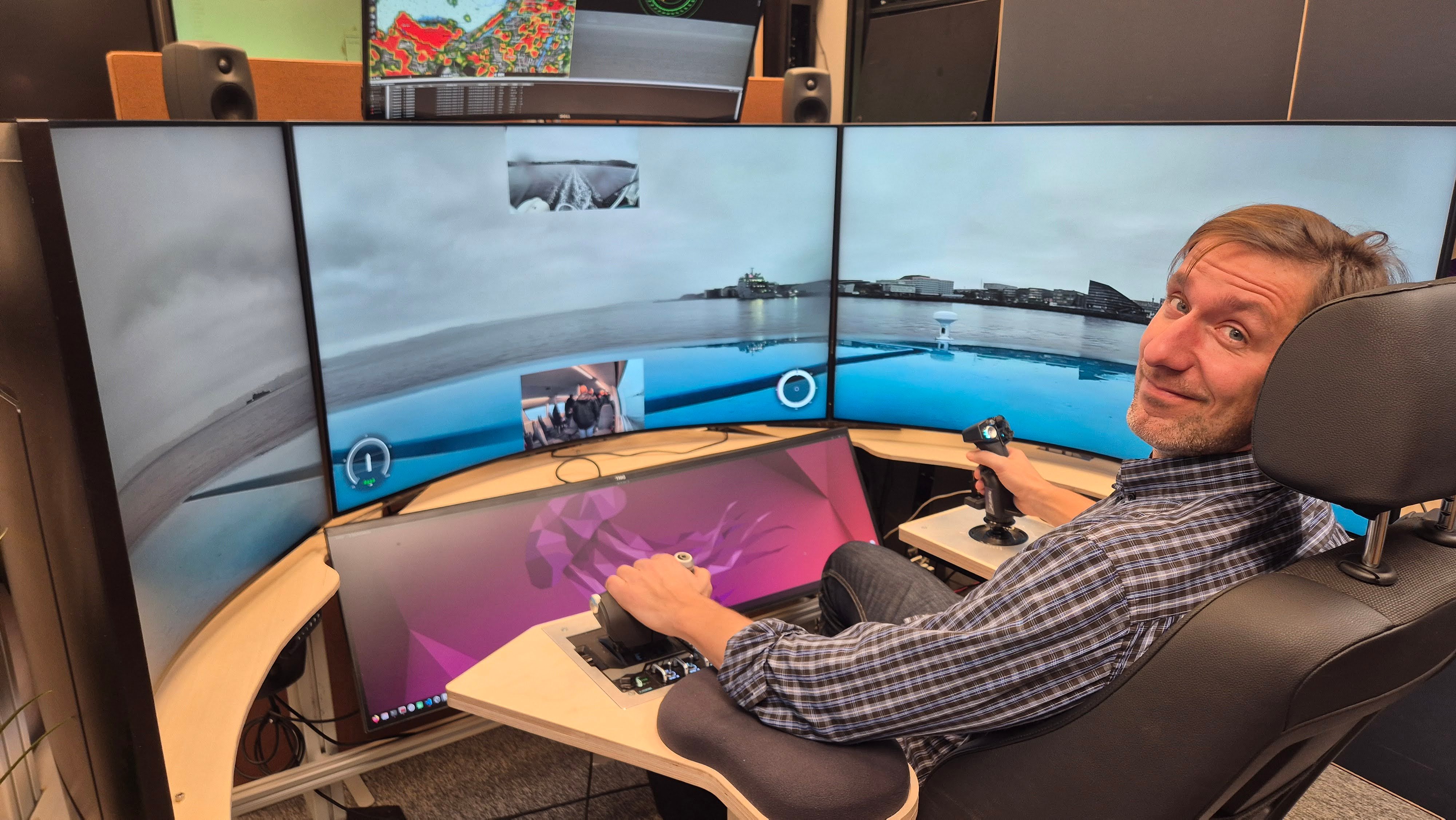 Ole Andreas Alsos, head of NTNU Shore Control Lab. Photo: Lars Bugge Aarset/Fremtidens Industri
– Just ten minutes after gaining access to the vessel, we were able to transmit the first live video images over the 5G network to the control room. This demonstrates how quickly this type of solution can be implemented, says Alsos.
– The next step is to demonstrate remote control of Frostabåten from the control room, explains Alsos.
.jpg?width=6000&height=4000&name=Frostab%C3%A5ten%20tirsdag%20-%20Foto%20Lars%20Bugge%20Aarset%20Fremtidens%20Industri%20(87).jpg) NTNU had planned four hours to set up the equipment onboard. They finished in just 30 minutes. Photo: Lars Bugge Aarset/Fremtidens Industri.
NTNU had planned four hours to set up the equipment onboard. They finished in just 30 minutes. Photo: Lars Bugge Aarset/Fremtidens Industri.
Frostabåten is an electric hydrofoil developed and produced by Candela. It is lifted out of the water by computer-controlled hydrofoils, which reduce friction and energy consumption, provide stability and comfort, and extend battery range compared to traditional boats.
Propulsion is provided by Candela C‑Pod motors with counter-rotating propellers, offering quiet, efficient, and maintenance-free operation. The combination of computer-controlled hydrofoils and direct electric propulsion makes the vessel highly energy-efficient and comfortable to sail.
– The most important thing now is to show that this works in practice. The technology is mature, and the vessel has already been in commercial operation in Stockholm’s public transport for over a year. Now it’s about engaging people and decision-makers to show that this is a realistic solution in Trondheim Fjord as well, says Alexander Sifvert, director for leisure sales at Candela.
.jpg?width=4898&height=3265&name=Frostab%C3%A5ten%20tirsdag%20-%20Foto%20Lars%20Bugge%20Aarset%20Fremtidens%20Industri%20(199).jpg) Alexander Sifvert, director for leisure sales at Candela. Photo: Lars Bugge Aarset/Fremtidens Industri
Alexander Sifvert, director for leisure sales at Candela. Photo: Lars Bugge Aarset/Fremtidens Industri
The Frostabåten project is carried out in close collaboration between Frosta Brygge, Trondheim Port, Ocean Autonomy Cluster, MIDAS, Crazy Coyote, WTW, Login Group, Norsk Droneindustri, SINTEF, Maritime Robotics, and FI Ocean Space Incubator. NTNU, with Shore Control Lab, is a key partner for testing and research on remote monitoring and autonomous systems.
Trondheim municipality and Trøndelag County are important public partners and contribute funding to the project.
.jpg?width=6000&height=4000&name=Frostab%C3%A5ten%20tirsdag%20-%20Foto%20Lars%20Bugge%20Aarset%20Fremtidens%20Industri%20(191).jpg) Mayor Kent Ranum attended the tests. Photo: Lars Bugge Aarset/Fremtidens Industri
Mayor Kent Ranum attended the tests. Photo: Lars Bugge Aarset/Fremtidens Industri
The project has also attracted significant interest from county authorities. Trøndelag County has indicated plans to support the purchase of electric vessels and the development of new routes, including through the Klimasats program.
– This is not just about one boat, but about developing a new mobility concept. Bus at sea, taxi at sea, and new connections that both reduce emissions and make better use of sea areas, says Hald.
In January, a new and more extensive test period is planned with additional trips, public demonstrations, and further technology testing.
.jpg?width=6960&height=4640&name=Frostab%C3%A5ten%20torsdag%2018%20desember%202025%20-%20Foto%20Lars%20Bugge%20Aarset%20Fremtidens%20Industri%20(17).jpg) Munkholmen could be one of Frostabåten’s stops. Photo: Lars Bugge Aarset/Fremtidens Industri
Munkholmen could be one of Frostabåten’s stops. Photo: Lars Bugge Aarset/Fremtidens Industri
FI Ocean Space Incubator has played a central role in structuring the project, connecting relevant actors, and enabling rapid progress.
– This project shows how the incubator model can be used to realize complex, interdisciplinary initiatives. Here, mobility, maritime technology, research, and regional development come together in a concrete test and development project with significant scaling potential, says Hald.
.jpg?width=6960&height=4640&name=Frostab%C3%A5ten%20torsdag%2018%20desember%202025%20-%20Foto%20Lars%20Bugge%20Aarset%20Fremtidens%20Industri%20(4).jpg) Head of FI Ocean Space Incubator Ingrid Sandnes and project manager for Frostabåten Linda Hald Photo: Lars Bugge Aarset/Fremtidens Industri
Head of FI Ocean Space Incubator Ingrid Sandnes and project manager for Frostabåten Linda Hald Photo: Lars Bugge Aarset/Fremtidens Industri
.jpg?width=6000&height=4000&name=Frostab%C3%A5ten%20tirsdag%20-%20Foto%20Lars%20Bugge%20Aarset%20Fremtidens%20Industri%20(39).jpg) Serial entrepreneur Terje Viken is a key driving force behind the Frostabåten project. Photo: Lars Bugge Aarset/Fremtidens Industri.
Serial entrepreneur Terje Viken is a key driving force behind the Frostabåten project. Photo: Lars Bugge Aarset/Fremtidens Industri.
.jpg?width=6000&height=4000&name=Frostab%C3%A5ten%20tirsdag%20-%20Foto%20Lars%20Bugge%20Aarset%20Fremtidens%20Industri%20(216).jpg) The company Crazy Coyote provides both boat operators for Frostabåten and a support boat for photographers. Photo: Lars Bugge Aarset/Fremtidens Industri.
The company Crazy Coyote provides both boat operators for Frostabåten and a support boat for photographers. Photo: Lars Bugge Aarset/Fremtidens Industri.
Drone photo: Frank Lervik/Screen Story
Offshore Sensing becomes a new member of Ocean Autonomy Cluster to strengthen collaboration on...
"Autonomy will be a key contributor to decarbonization and zero-emission vessels. We are proud to...
Maritime Guardian has joined Ocean Autonomy Cluster, strengthening the cluster’s...